“You Retire Once… I Help People Retire Everyday”
At the start of the year, the yield curve reflected an economy moving toward a more balanced footing: growth remained resilient, inflation was trending back toward target, and the labour market was gradually cooling. See purple line in chart below for reference.
Against that ‘Goldilocks’ backdrop, markets increasingly expected the Federal Reserve would have room to cut interest rates once or twice during 2026.
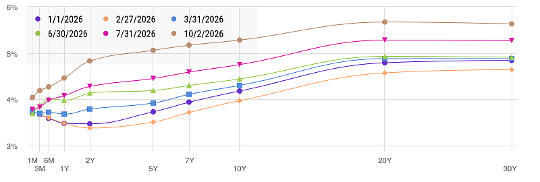
On Friday, February 27th (orange line) treasury yields hit their lowest levels of the year.
The turning point coincided with the outbreak of conflict in Iran on February 28th.Since then, higher energy prices and renewed inflation concerns have added meaningful upward pressure to yields, alongside several other factors.
The four factors that I believe are driving treasury rates to the levels we are seeing today are:
1. The U.S. economy is still quite strong. Stronger growth means investors think interest rates may need to remain higher for longer. Recent economic data have continued to show resilient activity.
2. Inflation isn't completely beaten. Energy prices and other inflation pressures have increased concern that inflation could remain above the Fed's comfort zone. If you're lending the government money for 10 or 30 years, you want a higher interest rate to compensate for that inflation risk.
3. The U.S. government needs to borrow a lot of money. Large fiscal deficits mean a very large supply of Treasury bonds has to find buyers. Basic supply and demand applies: more bonds for sale → investors demand a better yield to buy them.
4. Investors want a bigger "term premium." This is essentially extra compensation for locking money away for 10–30 years when there is uncertainty around inflation, government debt, interest rates and the economy. Recent analysis suggests higher expected real rates and term premium have been major contributors to the rise—not simply inflation expectations.
So, what does it mean for investors?
This is where I think plain and simple explanation matters most:
"The bond market is basically saying: if you want me to lend the U.S. government money for 10 or 30 years, you're going to have to pay me more."
That higher "risk-free" rate then gets transmitted through almost everything else.
· Mortgages get more expensive. U.S.mortgage rates have moved back above 7%.
· Corporate borrowing gets more expensive. If the U.S. government has to pay 5%+, companies generally have to pay considerably more than that. That can slow hiring, investment and acquisitions.
· Stocks face a higher hurdle. If investors can earn roughly 5% on a Treasury, they don't have to pay as high a valuation for stocks to justify taking equity risk. This tends to be particularly important for expensive growth companies whose expected profits are far into the future.
· Existing long-duration bonds fall in price. If you own an older 30-year bond paying 3–4% and newly issued bonds are paying 5%+, your old bond has to decline in price to become competitive.
But there's an important positive side: new money going into bonds is now earning much more attractive yields. For a diversified investor, a 5%+ Treasury yield creates a substantially better starting point for future fixed-income returns than existed when yields were 2–3%.
The simplest analogy I'd use is think of the U.S. government as a homeowner coming to the bank saying: "I need to borrow a lot more money, for a very long time, and there's uncertainty about inflation."
The lender responds: "That's fine—but at 3%, I'm not interested. Pay me 5%+ and we'll talk."
That's essentially what's happening.
I wouldn't describe the rise in yields as automatically "the bond market thinks America is in trouble." That's too simplistic. Right now, it's a combination of strong economic growth + inflation uncertainty + enormous borrowing needs + investors demanding greater compensation for long-term risk.
Higher yields can create volatility and tighten financial conditions in the short run, but they also improve the prospective return opportunity for fixed-income investors. In other words, rising yields aren't necessarily something investors should fear—they're a changing condition that creates both risks and opportunities.


