“You Retire Once… I Help People Retire Everyday”
“Guns and butter” is one of those economic phrases that sounds quaint until it starts looking relevant again. The term refers to a period in the mid-1960s when governments attempted to fund both ambitious domestic spending and rising defence expenditures without sacrificing economic growth.
At first, it worked remarkably well. GDP growth was strong, inflation was subdued, and unemployment was falling. Sound familiar?
Then things became a little less comfortable in the mid-to-late 1960s, often remembered as a period of economic difficulty. But that is not how it began.
At the outset, U.S. GDP growth was above 6%, inflation was below 2%, and unemployment was falling. The economy was doing so well that it was described using another familiar expression: Goldilocks.
Economic growth remained healthy and unemployment continued to improve, but inflation rose from below 2% to more than 6%. Bond yields climbed, equity valuations compressed, and the S&P 500’s price-to-earnings multiple fell from roughly 19 times at the beginning of 1965 to approximately 15 times two years later. It was a useful reminder that strong economic growth does not automatically translate into strong equity returns, particularly when inflation and the bond market decide to join the conversation.
History Rarely Repeats, but it often Rhymes
The original guns-and-butter era combined spending on the Vietnam War with the expansionary domestic policies of the “Great Society.” Today, investors are once again looking at significant fiscal spending, expanding federal deficits, geopolitical pressures and an economy operating near full employment. This time, the mix also includes a massive buildout of data centres and artificial intelligence infrastructure.
That last point matters for energy investors.
Data centres require enormous amounts of electricity. Expanding power generation, transmission networks and industrial infrastructure requires energy, steel, copper and other resource-intensive inputs. Whatever one thinks about artificial intelligence, it has yet to discover a way to run without electricity.
The historical comparison therefore raises a simple question: What happens when expansionary fiscal policy, rising deficits, geopolitical spending and infrastructure demand collide with constrained supplies of energy and natural resources? The answer may not be especially pleasant for inflation. It could, however, be considerably more interesting for energy producers.
The Crucial Difference
Resource equities did not consistently outperform during the original guns-and-butter period. But there was an important reason: commodity markets were heavily controlled.
Crude oil production was prorated by the Texas Railroad Commission and protected by import quotas. Natural gas prices were regulated below replacement economics. Gold was fixed at $35 per ounce, while copper traded at a government-administered price well below the free-market quotation. Demand for gasoline, copper, steel and electricity was rising, but market prices were not always allowed to reflect it.
That is the critical distinction between then and now.
Today’s commodity markets are not constrained by the same broad system of price controls. If demand rises faster than supply, prices have considerably more room to adjust. For energy producers, that creates the possibility that stronger commodity economics can flow through to revenue, cash flow and shareholder returns.
In other words, the 1960s had rising resource demand with the price signal partially unplugged. Today, the plug is very much in the wall.
The Bond Market May Already be Paying Attention
The U.S. 10-year Treasury yield began 1965 at approximately 4.2% and finished the decade near 8%.
Interestingly, the 10-year yield began 2026 at almost the same level as it did in 1965. That does not mean history is destined to follow the same path. Markets are not that considerate. But it does suggest that investors should take the risk of persistent inflation seriously.
If economic growth remains resilient while fiscal spending, defence requirements and power demand continue to expand, the potential inflationary pressure may not yet be fully captured in backward-looking data. Waiting for inflation statistics to provide a perfectly clear signal can be a bit like waiting for the smoke alarm before acknowledging that something smells burnt.
Inflation may come and go, but deficits tend to be stickier. The deficit expanded significantly during the1960s as Vietnam War and Great Society spending overlapped, but peaked at less than half the roughly 6% of GDP projected for 2026, well above the long-term average of 3.8% and a level the U.S. Congressional Budget Office described as “large by historical standards.”
When governments continue to spend beyond their revenues, the resulting fiscal impulse can create a powerful and persistent tailwind for commodities and other real assets.
Why Energy Deserves Another Look
At 3.36%, energy occupies a relatively modest weight in the S&P 500 compared with its historical representation. That leaves many investors with substantial exposure to companies that consume energy and resources, but relatively limited exposure to the businesses that actually produce them.
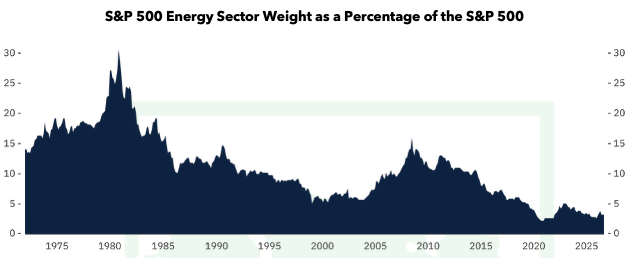
That imbalance may matter if the next phase of the economic cycle is defined by physical constraints rather than digital abundance.
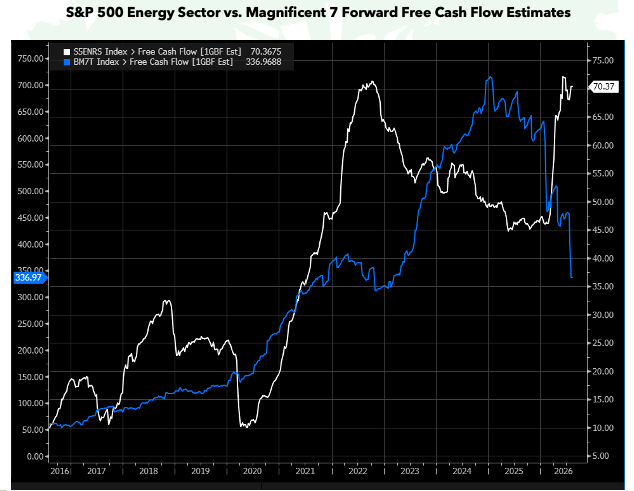
Energy companies provide exposure to assets that are difficult, expensive and time-consuming to replace. In a world of rising electricity consumption, geopolitical uncertainty and disciplined resource development, those assets may become increasingly valuable. The sector also offers something many growth-oriented parts of the market cannot always promise: substantial current free cash flow.
Estimated forward free cash flow for S&P 500 energy companies and the Magnificent Seven reinforces why the sector merits attention. Energy is not simply a tactical inflation trade. It represents ownership in businesses generating cash from resources the economy cannot easily do without.
Why it Matters
Investors have spent much of the past decade rewarding businesses built around intangible assets, low interest rates and seemingly unlimited scalability. That approach worked exceptionally well. But the coming investment environment may place a higher value on tangible assets, replacement costs and the ability to produce things the world physically needs.
Energy sits squarely inside that shift.
No historical analogy is perfect, and energy investing still carries commodity-price, geopolitical, operational and regulatory risks. But if today’s economy resembles the guns-and-butter period without the same commodity price controls, maintaining little or no exposure to energy may be a larger risk than many investors appreciate.
Investors do not need to choose between innovation and energy. The awkward reality is that innovation needs energy.
The cloud, after all, still plugs into the ground.


